
Object Record
Images

Additional Images [1]
Metadata
Catalog Number |
BR2023.13.47 |
Object Name |
Box, Needlework |
Description |
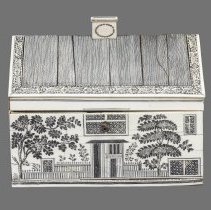
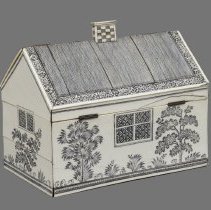
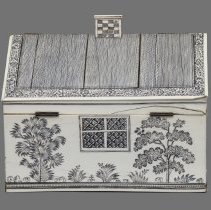
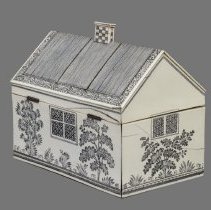
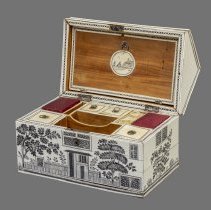
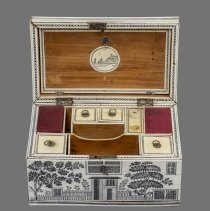
An Anglo-Indian Vizagapatam ivory and sandalwood 'workbox' or sewing box shaped like a house. The rectangular box has a lid that acts as a roof and a central chimney handle. It is a sandalwood box veneered with ivory. On all sides, it is etched with 'lac' to create an English cottage scene with trees, windows and a central door. The back and sides are also decorated with trees and lattice windows. The chimney front has an oval wreath while the back has a checkerboard pattern. The roof has a decorative floral border with vertical shingles. On the left-hand side is a storage drawer. The base is plain wood. In the centre of the bottom is a metal key. Inside there is a ceiling to the roof lid with a round medallion of two sailing ships beside land with a flag pole on top. The ceiling is plain wood with an ivory and lac border. Above the medallion is a circular metal handle. The roof is used for storing sewing tools. The bottom of the box is lined and has a sewing tray. The tray has two red silk rectangular pin cushions, four compartments with ivory veneer lids and metal ring handles, and an ivory veneered space for a thimble and tape measure (both shaped like an acorn). At the front are two rectangular wells for a threaded barrel and various tools. The interior edges all have an ivory and lac repeating pattern. |
Year Range from |
1795 |
Year Range to |
1815 |
Dimensions |
H-16 W-12 L-21 cm |
History |
This sewing box may have been bought at an auction in 1886. Among the Harris papers is a copy of a list of items sold at an auction with notations from Barbara Larson noting who in the family had the items. Not all the items were maked. Lot #267 " A unique Ivory Work Box, beautifully designed in the form of a cottage, exquisitely etched, and with finely fitted interior." sounds similar to this box. The advertising reads, " An interesting and important sale of Art Treasures from Ireland. These form the Second Portion, etc. of effects from two mansions, viz., Hermitage Park, County Dublin, the seat of the late Nugent Kenny Kingsmill, Esq., and the Barionial Mansion of Santry Court, the ancient abode of Sir C. Comption Dombille, Bart., Coolican & Co. Auctioneers, 38 Toronto St., Toronto, October 25th, 1886." Item possibly bought by Lucy or Bessie Harris. Vizagapatam was the best harbour between Madras and Calcutta on the east coast of India. It became a centre for exporting luxury goods to Britain and Europe. European tradesmen influenced the local craftsmen and they started making goods specifically designed to appeal to European consumers. By the late 18th century sewing boxes like this were sold by furniture dealers in the bigger cities. They could also be bought at auction in both India and Britain due to the high rate of illness and mortality amongst the English population. "Lac is the resinous secretion of a number of species of lac insects, of which the most commonly cultivated is Kerria lacca." It is used to make varnish, dyes, shellac, or sealing wax. References: https://en.wikipedia.org/wiki/Lac & Clare Muzzatti, Anglo Indian Sewing Boxes: The sewing boxes designed for the European market, but created and enhanced in India by those who lived there", 2018, https://needleworktoolcollectors.tripod.com/webonmediacontents/Anglo%20Indian%20Sewing%20boxes%20by%20Clare%20Muzzatti.pdf |
People |
Harris, Captain James Harris, Elizabeth Molony Harris, Bessie |