
Object Record
Images
Metadata
Catalog Number |
BE2003.2.167.1-2 |
Object Name |
Saltcellar |
Description |
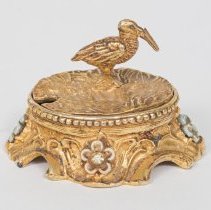
A gold-coloured salt cellar with a decorative dish and lid. The dish has a decorative scalloped base with four porcelain flowers with glass or diamond centres. The lid has a rippled surface upon which a long-beaked bird is standing, resembling a bird standing in water. A small cut out in the lid would hold a spoon. |
Year Range from |
1920 |
Dimensions |
H-4.5 W-4.5 L-5.3 cm |
History |
Salt cellars were ornamental containers used to store salt before the invention of the traditional "shaker" in 1858. Salt was widely used by early settlers to preserve food such as eggs and meat. Throughout history, humankind has held salt in high esteem. Before industrialization, salt was seen as not only a status symbol but a "must-have" table amenity as well. Traditionally, the salt cellar was given to the head of the table at the beginning of a meal before being passed around the table. This event was thought to be ceremonious in style. Where each guest sat at the table, in relation to the salt cellar, determined their status. In their day, salt cellars reflected one's role in society and their place in social structure. Oftentimes, salt cellars would be extremely ornate and would resonate with artistic pieces as opposed to utilitarian pieces. They were made of expensive materials and designed as pieces of art. This small salt cellar is quite decorative, despite its size. Resting atop the cellar is a crane standing in water. The entire piece has been gilded to add to its beauty. Before the salt shaker; salt cellars were highly decorative and ornamental pieces and could be very elaborate in their style. Salt cellars were not only used to hold the salt but also to keep the salt from moistening from humidity. Before moisture absorbents were invented, salt was unable to be ground into a fine powder, and therefore salt was used in larger, more crystallized chunks. Reference: 'A Brief History of Salt' by Time Staff. March 15 1982 https://time.com/3957460/a-brief-history-of-salt |