
Library Record
Images
Metadata
Catalog Number |
BE2003.2.259.1-3 |
Object Name |
Cookbook |
Title |
Patented and Improved Methods of Preserving and Canning Fruits |
Summary |
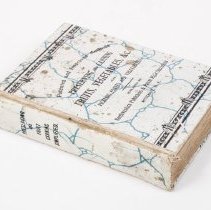
A hardcover cookbook entitled: Patented and Improved Methods of Preserving and Canning Fruits, Vegetables, etc., also Pickling Fruits and Vegetables. Published by The Northwestern Publishers and Patent Specialists in 1890. The thick book has a white cover with black printing and blue lines throughout (a marbled effect). A maroon bookmark is glued to the front endpaper. On the bookmark in white ink are the letter and numbers 'C' and '1895'. Contents of the book include recipes and helpful information for housekeepers. Found inside the cookbook is a 25.5 x 20.5 cm piece of paper with handwritten instructions for knitting bloomers as well as another handwritten note featuring a recipe for Pineapple Pudding. The back of this note is marked with the text: 'Miss Annie Harris B.S.S. Toronto.' |
History |
Cookbook was used by Mary, Annie and Naomi Harris of Benares. Home canning became a widespread occurrence in a lot of households after the invention of the Mason Jar in 1858 by John L. Mason. Historically foods were often preserved using crude glass and earthenware containers that were sealed with cork or parchment. Families also participated in other forms of preservation in the form of pickling, drying and smoking. It was French Chef Nicholas Appert who introduced the concept of preserving food through the act of forming an air-tight seal; in 1810 he published a book called the 'L' Arte de Conserver les Substances Animales et Vegetables'. Early glass jars were often sealed with wax or 'cement' that the manufacturer had to pour around the mouth of the container; the food preserver would then have to heat the wax and press the lid to form a seal. The Mason Jar was patented in 1858 and consisted of a glass container with a thread moulded into its top and a zinc lid that has a rubber ring. The rubber ring would seal the lid into the jar without the use of any wax or 'cement'. This was an ideal way to preserve food because the jars could be easily sealed and opened and it was reusable. Although the most popular mason jar construction has a metal lid, some did have glass lids with metal threads. Canning decreased in popularity in the mid-20th century, but the practice of preserving is seeing a renaissance in the 21st century due to an increased desire for affordable, nutritious and environmentally friendly food. Ref: www.masonjars.com/history-of-ball-jars.html |
Subjects |
Canning & preserving Cook Books Hardcover Non-Fiction Recipes |
People |
Harris, Annie Harris, Mary Harris, Naomi |